
Homeowner guide
Water softener vs. water filter: which fits your home?
Choose a softener, a point-of-use filter, a whole-home filter, or more testing based on a documented water condition—not a broad product claim.
Published October 6, 2026
By the HomeFAQ Editorial Team · Reviewed for accuracy.
https://homefaq.com/water-treatment/water-softener-vs-water-filter/
Printing is unavailable. Use your browser’s Print command.
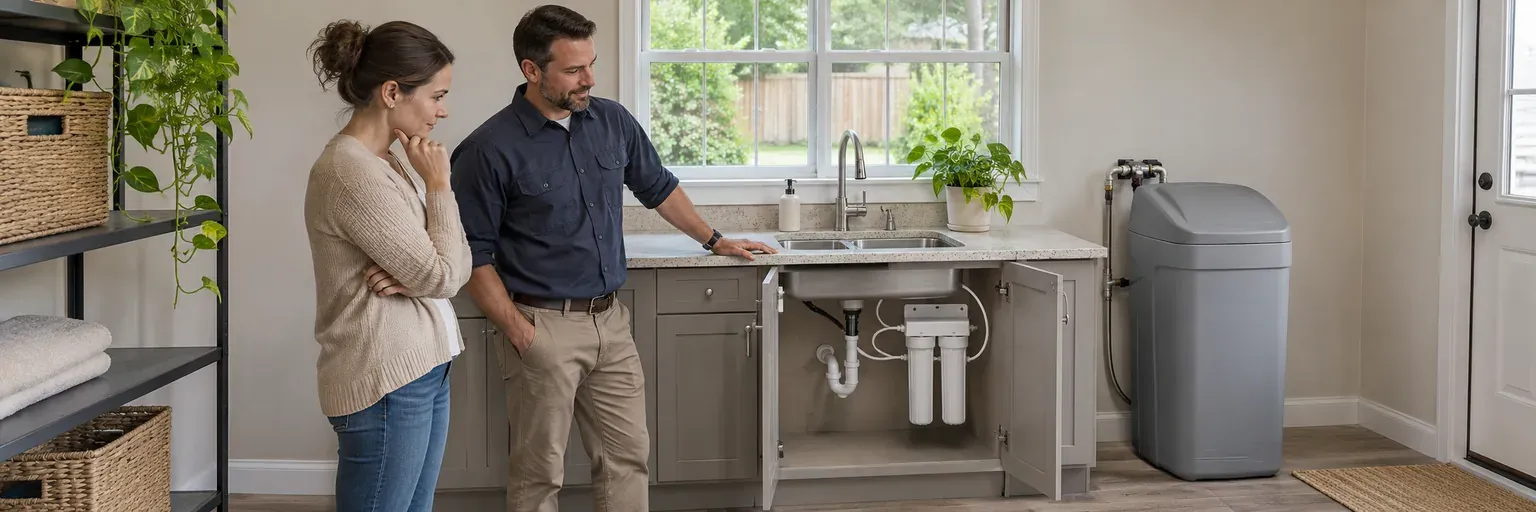
Choose a water softener when a reliable test or water report identifies hardness and your goal is to reduce the scale that hard water can leave on plumbing fixtures or appliances. Choose a filter only when its specific certification and treatment claim match a documented concern. A small point-of-use filter may fit drinking water at one faucet; a whole-home filter may fit a documented need at the building entry. If you do not yet know what is in the water, the better first step is testing or reviewing your water system’s report—not buying either device.
This guide is for a homeowner who has noticed scale, taste, odor, staining, or a report result and wants to understand the next question. Hardness is dissolved calcium and magnesium in water. A contaminant is a substance in water that may need separate evaluation or treatment. They are not interchangeable problems, so a softener is not a universal water-safety device and a filter is not automatically a solution for hardness.
Start with the water source and the documented concern
For public water, begin with the system’s current Consumer Confidence Report and any local notices. That report describes the public system’s water, but it may not answer a concern created by plumbing inside one home. For a private well, testing is the owner’s responsibility; EPA recommends regular testing and additional testing after conditions such as flooding that may affect the well. A taste, odor, stain, or scale deposit is a reason to ask a question, not a diagnosis.
Tell a state or local health department, certified laboratory, or qualified water professional whether you use public water or a well and what you observed. Follow the laboratory’s sample instructions. The result should identify what was tested, when, and at what location. Do not rely on a retailer label, a neighbor’s water condition, or a broad “clean water” claim to select equipment.
Compare the job each option is meant to do
| Option | Often a better fit if… | It is not a substitute for… | Ask for this in writing |
|---|---|---|---|
| Water softener | A reliable result identifies hardness and scale reduction is the stated goal. | A diagnosis or treatment plan for a different documented contaminant. | The hardness result, sizing assumptions, regeneration method, drain/discharge needs, maintenance, and what the system does not claim to treat. |
| Point-of-use filter | The concern is at a specific drinking-water tap and the product’s certification matches the documented claim. | Evidence that the rest of the home’s water, plumbing, or well condition has been evaluated. | The exact model, faucet/location, certified reduction claim, replacement schedule, and installation limits. |
| Whole-home filter | A qualified professional can explain why treatment at the building entry matches the documented condition and household demand. | A blanket promise to treat every concern or a hidden plumbing, well, or source-water problem. | The treatment target, test result, flow assumptions, bypass/shutoff details, service needs, and exclusions. |
| Further testing or evaluation | The result is missing, unclear, old, or does not explain the symptom. | A product purchase made to cover uncertainty. | The question being tested, laboratory method, sample instructions, and who can interpret the result. |
The table is a decision aid, not a performance ranking. The Centers for Disease Control and Prevention notes that treatment choices depend on the contaminant or condition. NSF certification is also product- and claim-specific: a certification mark does not mean a device removes every substance or solves every water problem.
When a softener is often the clearer fit
If a report identifies hardness and the practical problem is mineral scale, a softener may be worth comparing. Ask the professional to explain the result, the expected household demand, the exact model, and the maintenance the system needs. A softener proposal should also state how it regenerates, where any discharge goes, and what plumbing or electrical work is included.
Do not treat a softener as a general answer to an unexplained taste, odor, public-water notice, microbial concern, or test result for another substance. If a proposal says it handles a separate concern too, ask for the exact certified claim and the evidence that the claim matches your result. A device can be appropriate for one job while leaving another job unresolved.
When a filter may be the better fit
A point-of-use filter can be a narrower choice when the documented target is drinking water at one location and the product has a relevant certified claim. A whole-home filter can be worth discussing when the documented condition and household use call for treatment before water reaches fixtures. In either case, ask whether the proposal is for taste, odor, a specific tested substance, particles, or another stated target. “Filter” describes a product category, not a promise of what the unit removes.
Filters also have limits. Their media or cartridges need replacement on the stated schedule, and installation conditions can affect whether a model fits the home. A product that helps at one faucet may not address scale throughout the house. A whole-home proposal may not address a concern that originates in a well, building plumbing, or an emergency water notice. Follow a public water system’s instructions for notices; do not assume household equipment changes those instructions.
Do not choose equipment before the evidence is clear
Pause before choosing any system if the result is missing, is from a different location or time than the concern, or does not identify what was tested. Also pause if a proposal names a product but not the treatment target, certification claim, household-flow assumption, installation scope, maintenance, or exclusions. Those gaps make it impossible to tell whether two offers solve the same problem.
Keep your report or test result, the sample date, your water source, and notes about where the issue appears together. From accessible areas only, you can note whether the symptom occurs at hot water, cold water, one fixture, or several. Do not alter plumbing, disinfect a well, or collect a sample outside the laboratory’s instructions. Use How to plan home water testing and treatment to organize the information, then use How much should home water treatment cost? to request comparable scopes.
Questions to ask your water-treatment professional
- Which current test result or water report supports the specific condition this softener or filter is intended to address, and what does it not address?
- What exact model and certified treatment claim are you proposing, and how does that claim match my water source, sample location, and household use?
- What plumbing, drain or discharge, electrical, maintenance, replacement-media, testing, warranty, and change-order items are included or excluded from this scope?
Sources
- U.S. Environmental Protection Agency, Consumer Confidence Reports — public-water-system report context.
- U.S. Environmental Protection Agency, Private Drinking Water Wells — private-well owner testing and maintenance context.
- Centers for Disease Control and Prevention, Water Treatment — treatment methods vary by water condition or contaminant.
Be ready for the conversation
3 questions to ask your water treatment professional
- 1Which current report or test result supports this recommendation, and what condition is the scope intended to address?
- 2Which equipment, installation, startup, testing, permits, removal, cleanup, and recurring supplies are included or excluded?
- 3Which flow, plumbing, drain, access, or water-quality assumption could change this proposal, and how will you document it?
Keep planning
Related water treatment guides
How much should home water treatment cost?
A scope-first guide to budgeting for water testing, filtration, softening, or another treatment system without mistaking a planning figure for a quote.
How to plan home water testing and treatment
A safe, step-by-step way to get the right water-quality information before choosing testing or a treatment system.
How to compare water-treatment estimates
Compare water-treatment proposals by the test result, treatment target, flow demand, installation scope, maintenance, certification, warranty, and exclusions—not the total alone.