
Homeowner guide
How to compare water-treatment estimates
Compare water-treatment proposals by the test result, treatment target, flow demand, installation scope, maintenance, certification, warranty, and exclusions—not the total alone.
Published October 6, 2026
By the HomeFAQ Editorial Team · Reviewed for accuracy.
https://homefaq.com/water-treatment/how-to-compare-water-treatment-estimates/
Printing is unavailable. Use your browser’s Print command.
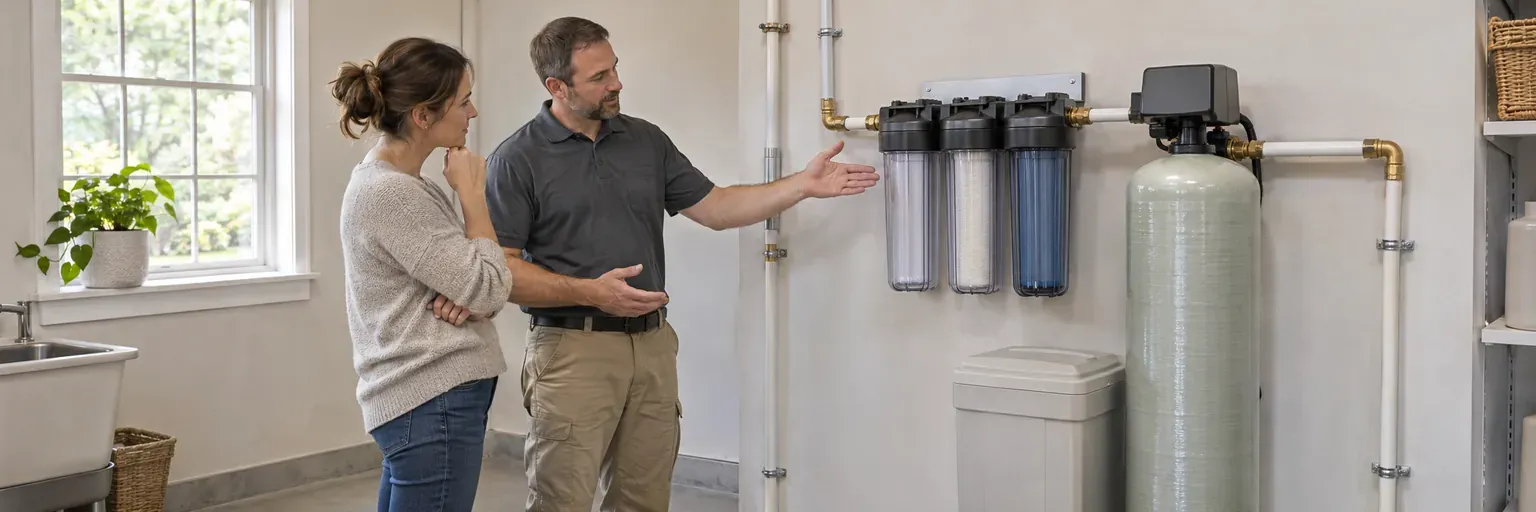
Choose the proposal that clearly matches a documented water concern and your home’s needs—not simply the lowest price. A water-treatment estimate can cover a laboratory test, a drinking-water filter at one faucet, a whole-home softener or filter, installation changes, and future maintenance. Those are different jobs. Start with the same report or test result, household details, and treatment goal for every provider. Then compare what each written proposal says it will treat, install, test, maintain, and leave out.
This guide is for a homeowner who has a water-quality report, laboratory result, or specific concern and is deciding between proposals. The practical rule is to separate testing from treatment installation. A laboratory result can identify what was in a sample; it does not itself select equipment or prove that every product marketed for a concern fits your plumbing, water source, or household demand.
Start with matching evidence
Give each provider the same current report or laboratory result, including the sample date, sample location, water source, and the condition you want to address. For public water, a Consumer Confidence Report is useful background, but it reports on the public system and may not describe water after it moves through a building’s plumbing. Private-well owners are responsible for testing and should use current local health-department and laboratory guidance. Write down whether your goal is a documented contaminant or condition, scale associated with hardness, drinking-water treatment at one tap, or a question that still needs evaluation. A taste, odor, stain, or scale deposit can be useful context, but it is not a diagnosis. Do not collect a sample with an improvised container, alter plumbing, or open electrical equipment to prepare for an estimate; laboratories can have specific bottles, sample locations, and holding times.
Compare the same written scope
| Item | What should be written down |
|---|---|
| Test result and treatment target | The report reviewed, exact condition addressed, and conditions not addressed. |
| System and certification | Manufacturer, model, treatment method, and specific relevant certification or performance claim. |
| Flow-rate demand and sizing | Household occupants, simultaneous fixtures, plumbing assumptions, and one-faucet or whole-home coverage. |
| Installation scope | Labor, fittings, shutoffs or bypasses, drain or discharge work, electrical work, access, startup, cleanup, and permit responsibility. |
| Testing and handoff | What will be checked after installation and whether follow-up testing is included or separately priced. |
| Maintenance | Replacement filters, media, salt, service, monitoring, retesting, and expected homeowner tasks. |
| Warranty and exclusions | Equipment and labor terms, coverage conditions, omitted work, and the written change-approval process. |
Use the same rows even when one proposal is short. A product price is not comparable with an installed system if the installed proposal includes plumbing work, startup, or maintenance supplies. Likewise, a whole-home system is not interchangeable with a point-of-use system merely because both are called filters.
Check that the claim and size fit
Ask each provider to connect the proposed equipment to the result or stated goal in plain language. NSF explains that certification applies to particular product claims; it is not a promise that a device addresses every water issue. Record the exact model and claim instead of accepting “purifies water.” The proposal should state its assumptions about simultaneous fixtures, household use, installation location, drains, and electrical needs. A provider may need to inspect accessible plumbing or request more information before finalizing a scope; that is more useful than an unsupported universal size. If providers reviewed different tests, ask whether they are pricing the same treatment target. Do not ask for a health, performance, or savings guarantee that the documented result and product claim do not support.
Compare ownership, not only installation
Treatment systems can create recurring responsibilities. Before comparing totals, ask for replacement schedules and expected consumables, service, monitoring, and retesting tasks. Ask who performs each task and what happens if the system is not maintained as specified. A lower installation total can be a different scope when it excludes replacement media, service visits, drain work, or the labor needed to make the system accessible. Keep testing separate on every proposal. A testing fee may cover a laboratory panel, sampling instructions, or professional interpretation; installation may be authorized only after the results are understood. If a provider combines them, request separate line items so equipment is not being recommended before the evidence supports it.
Get exclusions and changes in writing
Water-treatment installation can uncover an access, plumbing, drain, electrical, or well condition outside the original scope. That does not make a proposal untrustworthy, but it should identify assumptions and explain how changes are handled. Ask for written notice of the condition, options, price or schedule effect, and your approval before added work begins. Local permit and discharge requirements vary, so ask who will check requirements for the actual location and scope.
Comparison checklist
- Give every provider the same report or test result and household-use details.
- Mark each proposal’s target, model, certification, sizing, installation, testing, maintenance, warranty, and exclusions.
- Request separate lines for testing or evaluation, equipment, installation, and recurring maintenance.
- Keep a written record of exclusions and the change-approval process before authorizing work.
Questions to ask your water-treatment professional
- Which dated test result or stated condition does this model address, and which conditions does it not address?
- What flow-rate, household-use, plumbing, drain, and electrical assumptions did you use to size and install this system?
- What maintenance, follow-up testing, warranty conditions, and possible installation changes are included in this price, and what requires my written approval?
Next step
Before requesting proposals, use How to plan home water testing and treatment to organize safe, useful information. For a scope-first budgeting framework, read How much should home water treatment cost?.
Sources
- U.S. Environmental Protection Agency: How to Find Your Water Quality Report — Consumer Confidence Reports and public-water-system context.
- U.S. Environmental Protection Agency: Testing Your Private Well — private-well testing and laboratory sampling context.
- Centers for Disease Control and Prevention: Water Treatment — treatment methods vary with the contaminant or condition.
- NSF: Drinking Water Treatment Units — product certification and treatment-claim context.
- Federal Trade Commission: Hiring a Contractor — written scope, estimates, and contract-comparison guidance.
Be ready for the conversation
3 questions to ask your water treatment professional
- 1Which current report or test result supports this recommendation, and what condition is the scope intended to address?
- 2Which equipment, installation, startup, testing, permits, removal, cleanup, and recurring supplies are included or excluded?
- 3Which flow, plumbing, drain, access, or water-quality assumption could change this proposal, and how will you document it?
Keep planning
Related water treatment guides
How much should home water treatment cost?
A scope-first guide to budgeting for water testing, filtration, softening, or another treatment system without mistaking a planning figure for a quote.
How to plan home water testing and treatment
A safe, step-by-step way to get the right water-quality information before choosing testing or a treatment system.
Water treatment terms homeowners should know
Plain-English water-treatment terms to help homeowners read test results, product claims, and written installation proposals.