
Homeowner guide
How much should home water treatment cost?
A scope-first guide to budgeting for water testing, filtration, softening, or another treatment system without mistaking a planning figure for a quote.
Published October 5, 2026
By the HomeFAQ Editorial Team · Reviewed for accuracy.
https://homefaq.com/water-treatment/how-much-should-water-treatment-cost/
Printing is unavailable. Use your browser’s Print command.
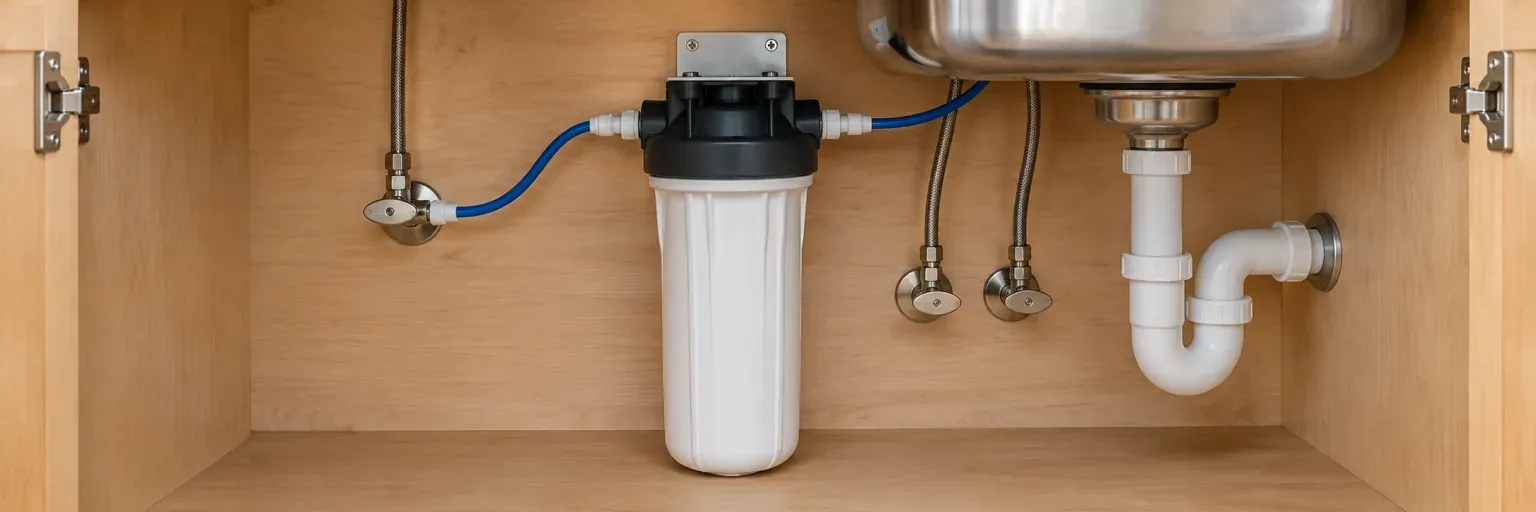
If you are deciding whether to budget for home water treatment, start with a documented water concern and a written scope—not a national average. A water test, a point-of-use filter, a whole-home filter, a softener, reverse osmosis, plumbing changes, and ongoing service solve different problems and can have very different installed costs. There is no single safe national planning range that covers them all without hiding the treatment target, water source, household demand, installation conditions, and maintenance commitment. Use this guide to decide what belongs in your budget request, then compare like-for-like written proposals.
This guide is for a homeowner who has noticed a water issue, received a test result, or is planning a system and needs to decide what to investigate before collecting prices. The practical rule is simple: budget first for the relevant test or existing water-quality record, then request prices only for a treatment target that the result and a qualified professional can explain. Do not buy a system just because it is marketed for a broad concern.
Separate the possible jobs before asking about cost
“Water treatment” can mean several separate jobs:
- Getting a current report from a public water system or arranging a relevant test, especially for a private well.
- Treating an identified concern at one faucet, such as drinking water, with a point-of-use device.
- Treating water at the building entry with filtration, softening, or another whole-home system.
- Adding installation work: plumbing changes, drain connections, electrical work, access work, permits where required, or correction of a separate well or plumbing condition.
- Maintaining the system through replacement media, filters, salt, service visits, monitoring, or testing.
Those are not interchangeable. The U.S. Environmental Protection Agency explains that public water systems provide annual Consumer Confidence Reports, while private well owners are responsible for testing their wells. A report or test can identify a question to investigate; it does not by itself choose equipment or prove that one product fits every household.
Why a headline price is usually not enough
An advertised product price may omit the work that makes a system usable in your home. Before treating any number as a planning input, ask whether it includes the exact model and certification, labor, required fittings and valves, bypass or shutoff arrangements, drain or discharge work, electrical work, delivery, removal of an old unit, startup, testing, cleanup, permits or inspections if applicable, and taxes. Also ask what it excludes.
The treatment target changes the scope. Hardness is the amount of dissolved minerals commonly associated with scale; it is different from a specific contaminant. A softener may be proposed for hardness, while a filter or another treatment method may be proposed for a different documented concern. The Centers for Disease Control and Prevention notes that different contaminants require different treatment approaches. A system should name the concern it is intended to address rather than make a vague “clean water” promise.
Build a useful budget request
Give every professional the same short packet:
- Your water source: public system or private well.
- The relevant current report or laboratory result, including sample date and what was tested.
- Household details that can affect sizing, such as occupants, fixtures used at the same time, visible plumbing location, and access constraints.
- Your goal: drinking-water treatment at a specific faucet, scale reduction, an identified test result, or a question that still needs evaluation.
- Photos and notes taken safely from accessible areas only. Do not open electrical panels, alter plumbing, or collect a sample using a method the laboratory did not provide.
Request a written scope that distinguishes testing or evaluation from equipment installation. If the result is unclear, the right next expense may be an appropriate test or professional evaluation—not a treatment system.
Compare the full ownership cost
For each proposal, keep one line for the installed scope and another for expected recurring responsibilities. Ask for the manufacturer model number, the specific standard or contaminant claim where applicable, the replacement schedule, consumables, any service-plan terms, warranty terms, and the homeowner tasks needed to keep the system operating. NSF advises consumers to look for certification information that matches the product’s actual claim; certification does not mean every device treats every possible concern.
Do not compare a product-only total with an installed, tested, and maintained scope. A lower proposal may be appropriate if it treats one faucet rather than the whole home, uses a different treatment method, assumes easier access, omits ongoing supplies, or excludes plumbing work. It is not a useful comparison until those differences are written down.
Keep estimates and quotes in their proper place
An online price, a retailer listing, or a broad national average is only a starting point for questions. It cannot confirm your water condition, flow needs, local requirements, drain arrangement, plumbing condition, or whether a proposed device’s certification matches the documented concern. A local written quote should identify its assumptions and change process. If a professional finds a condition outside the scope, ask for the finding, options, and price effect in writing before authorizing more work.
Your next action is to organize the report or test result and request matching written scopes. Return to the Water Treatment hub as additional testing, comparison, and terminology guides are published.
Sources
- U.S. Environmental Protection Agency: How to Find Your Water Quality Report — Consumer Confidence Reports and public-water-system information.
- U.S. Environmental Protection Agency: Private Drinking Water Wells — private-well owner responsibilities and testing context.
- Centers for Disease Control and Prevention: Water Treatment — treatment methods vary with the contaminant or condition.
- NSF: Drinking Water Treatment Units — certification and product-claim context.
- Federal Trade Commission: Hiring a Contractor — written estimates, contract scope, and comparison guidance.
Be ready for the conversation
3 questions to ask your water treatment professional
- 1Which current report or test result are you using for this recommendation, and what specific condition is this scope intended to address?
- 2Which equipment, installation work, startup, testing, permits or inspections, removal, cleanup, and recurring supplies are included or excluded in this total?
- 3Which flow, plumbing, drain, access, or water-quality assumptions could change this price, and how will you document and obtain approval for a change?
Keep planning
Related water treatment guides
How to compare water-treatment estimates
Compare water-treatment proposals by the test result, treatment target, flow demand, installation scope, maintenance, certification, warranty, and exclusions—not the total alone.
Water treatment terms homeowners should know
Plain-English water-treatment terms to help homeowners read test results, product claims, and written installation proposals.
How to plan home water testing and treatment
A safe, step-by-step way to get the right water-quality information before choosing testing or a treatment system.