
Homeowner guide
Deck and patio maintenance checklist: safe seasonal checks
Use safe ground-level checks to spot loose surfaces, water problems, and warning signs on a deck or patio before arranging qualified help.
Published October 1, 2026
By the HomeFAQ Editorial Team · Reviewed for accuracy.
https://homefaq.com/patios-decks/deck-and-patio-maintenance-checklist/
Printing is unavailable. Use your browser’s Print command.
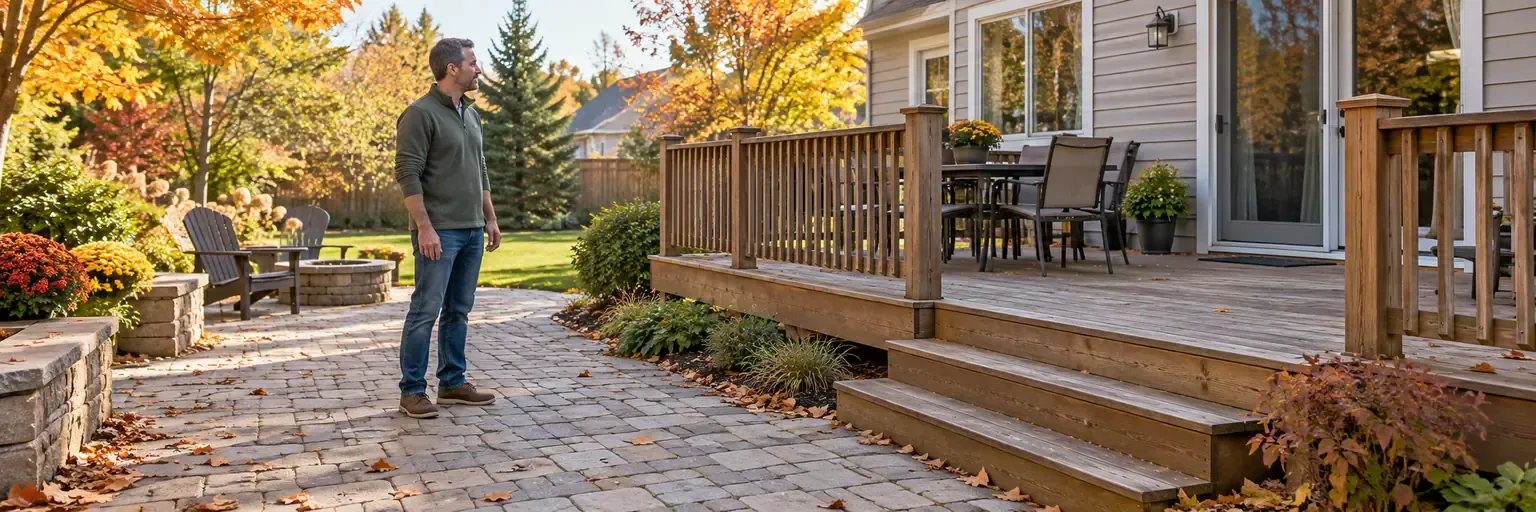
You can catch many deck and patio problems without climbing, digging, or testing a structural connection yourself. Walk the area in daylight from stable ground, look for changes in surfaces, stairs, railings, and drainage, and save dated photos. A loose guard, notable movement, decay, major settling, or water reaching the house is a reason to stop using the affected area as needed and ask a qualified professional for an evaluation.
This checklist is for routine seasonal observation of an existing deck or patio. It does not tell you whether a structure is safe, whether a repair needs a permit, or how to fix a drainage or structural problem. Local rules and the site condition control those decisions.
1. Start with a safe walkaround
Choose a dry day with good light. From the ground, look at the deck, patio, nearby steps, railings, and the connection to the house without moving boards, removing fasteners, or probing soft-looking wood. Take wide photos first, then photos of any change with a familiar object nearby for scale.
Look for a new dip or trip edge in a patio, cracked or displaced units, loose deck boards, visible rot, corrosion, missing hardware, or a railing that looks out of line. Notice whether a stair tread, handrail, gate, or transition feels loose under normal use. Do not deliberately shake a railing or bounce on a deck to test it. If something appears unstable, keep people away from that section and arrange an assessment rather than trying to confirm the cause yourself.
2. Watch where rainwater goes
Observe the area during or after ordinary rain from a safe location. Note water that pools on the patio, runs toward the house, erodes soil, splashes against siding, or collects at a post base, step, or door. Photograph the pattern and record when it happened. Water can come from several site conditions, so the observation is useful evidence—not a diagnosis.
Keep leaves and loose debris off walking surfaces when you can do so from the ground. Do not excavate beside the house, change a slope, add fill against siding, or assume a sealant will solve water entry. If water reaches the foundation, enters the house, repeatedly undermines a surface, or leaves a slippery route, ask a qualified professional to explain the likely scope and whether drainage, grading, or a separate building concern needs attention.
3. Check deck surfaces and supports without climbing underneath
From the deck surface and surrounding ground, look for split or lifted boards, protruding fasteners, persistent soft-looking areas, mushroom-like growth, or gaps that have changed since the last check. Sweep away debris only if the surface is stable and you can do it without leaning over an edge. Never crawl under a deck, remove a board, or use a screwdriver to test wood or connections; that can create a hazard and cannot establish structural condition.
From a normal viewing position, note posts that appear out of plumb, footings with exposed soil or erosion, or beams and hardware with obvious damage. A deck can rely on connections and components that are not visible to a homeowner. The American Wood Council’s prescriptive deck guide is a design resource for qualified use; it is not a home inspection checklist or a substitute for local requirements.
4. Keep stairs, guards, and walking routes clear
Clear leaves, ice, planters, cords, and furniture that narrow a walking route. Check that outdoor lighting works before using stairs after dark. Do not place planters or heavy storage on a railing, attach a hammock or swing to an unverified structural member, or use a railing as a lifting point.
Promptly arrange professional help for a loose or damaged handrail or guard, a stair that shifts, a cracked support, a large or growing patio displacement, or a deck that visibly sags. Keep children and guests away from a section that may not support normal use. If a fall, collapse, downed line, or other immediate danger has occurred, use local emergency help rather than waiting for routine maintenance.
5. Make a simple seasonal record
At the start and end of the outdoor season, save photos, dates, repair receipts, and notes about water patterns or changes in one folder. Record the location, weather, and whether the issue is new or recurring. This gives a contractor a clearer starting point and helps you compare whether a proposed repair addresses the same condition you observed.
For planned maintenance such as cleaning, refinishing, or replacing a surface material, ask what preparation, hidden-condition allowance, drainage protection, cleanup, and warranty terms are included. Use How to plan a deck or patio project to prepare a site brief, then use How to compare deck and patio estimates to compare written scopes rather than totals alone.
Questions to ask your deck or patio professional
- Which visible conditions do you want to inspect further, and what parts of the structure or drainage path will that inspection include?
- Does the proposed work address the water pattern I documented, and what site conditions could require a separate drainage or grading scope?
- If you find concealed decay, settlement, or connection damage, how will you document options and obtain written approval before additional work begins?
Sources
- OSHA: Walking-Working Surfaces — fall-prevention context for keeping walking routes clear and addressing unsafe conditions.
- American Wood Council: Prescriptive Residential Wood Deck Construction Guide — technical deck-construction reference; local adoption and site-specific design requirements vary.
- International Code Council: Deck construction resources — deck safety reference material; local authorities determine applicable requirements.
Be ready for the conversation
3 questions to ask your deck or patio professional
- 1What site conditions, drainage, access, or local requirements affect this scope?
- 2Which structural or base-preparation details are included, and which need further evaluation?
- 3What could change after removal or excavation, and how will you document it before work proceeds?
Keep planning
Related patios decks guides
How to compare deck and patio estimates
Compare deck and patio proposals by written scope, site preparation, drainage, approvals, and change control—not just the bottom-line price.
How to plan a deck or patio project
Plan a deck or patio with safe site observations, clear priorities, and a written scope that a qualified professional can evaluate.
How much should a deck or patio cost?
Plan a deck or patio project by comparing complete written scopes when public national data cannot support one reliable installed-price range.