
Homeowner guide
Spot drainage and concrete safety concerns
Learn which visible concrete, masonry, and drainage conditions call for keeping people away, documenting what you see, or arranging a qualified assessment.
Published October 2, 2026
By the HomeFAQ Editorial Team · Reviewed for accuracy.
https://homefaq.com/concrete-masonry/how-to-spot-drainage-and-concrete-safety-problems/
Printing is unavailable. Use your browser’s Print command.
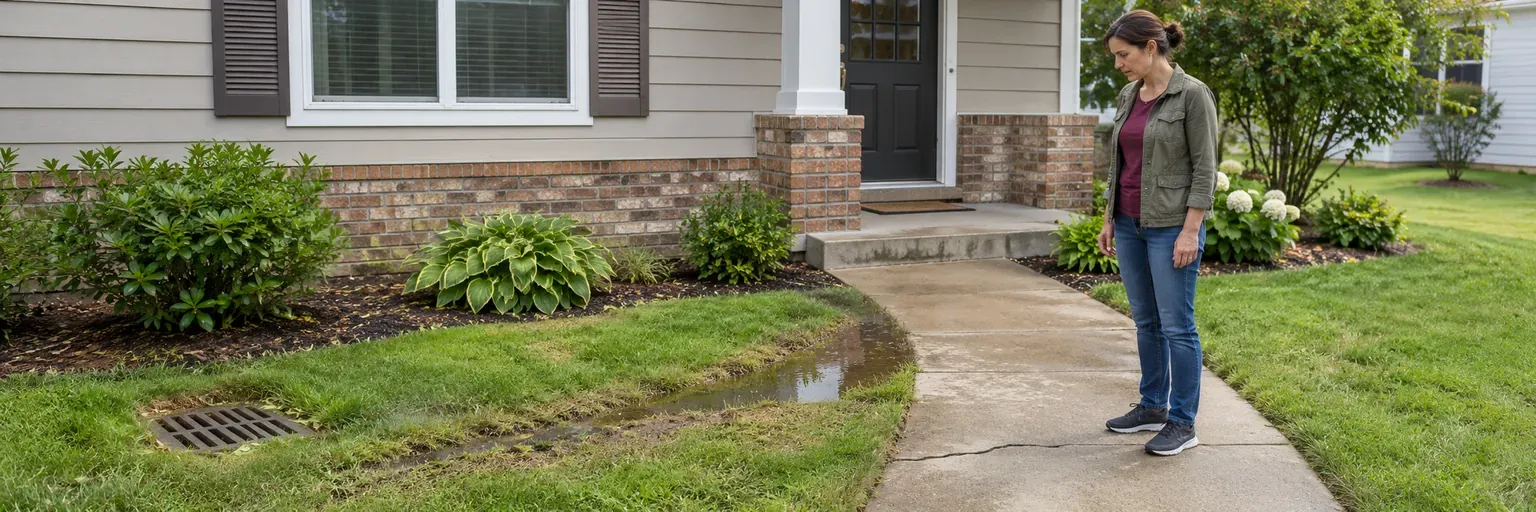
If a concrete or masonry area is changing quickly, creating a trip or falling hazard, leaning, shedding material, or directing water toward your home, keep people away from the immediate area and arrange the right qualified help before trying to repair it. Ground-level photos and simple notes are useful; probing a crack, digging near a foundation, climbing on a wall, or trying to straighten or level a heavy section is not. A small, stable-looking surface crack may be a planning issue, while a shifted walkway, a leaning retaining wall, or water entering the home needs more prompt attention. This guide helps you observe safely, not diagnose a slab, wall, foundation, or drainage system.
Call emergency services when a collapse is happening or appears imminent, someone is injured, a downed power line is involved, or you cannot keep people away from an immediate danger. If water is near electrical equipment, do not enter the area or touch outlets, cords, panels, or appliances. The U.S. Consumer Product Safety Commission cautions that water and electricity are a dangerous combination.
1. Start with the safe decision rule
Stay on firm, dry ground and look only from a distance that does not put you below, beside, or on a damaged structure. Keep children, pets, visitors, and vehicles out of a cracked or unstable-looking area. Use another route if a step, driveway edge, walkway, patio, stair, or entry surface has changed level enough to catch a foot, wheelchair, stroller, or tire.
Do not assume that a crack tells you why it happened. Concrete can crack as it shrinks and ages, but movement, water, support, loading, roots, or freeze-thaw exposure can also matter. A control joint is a planned line intended to help manage where a slab cracks; it does not prove that a nearby crack is harmless. Likewise, a damp spot or pooled water does not identify the source by itself.
Treat these observations as reasons to pause and seek an appropriate assessment rather than as proof of a cause:
- A wall is leaning, bulging, separating, dropping pieces, or has a widening gap at an attachment.
- A walkway, driveway, step, patio, or slab has a raised, dropped, broken, or rocking section that changes safe use.
- Soil is washing away, a void is visible, water is flowing toward the house, or water is entering a basement, crawl space, or living area.
- New movement appears near a foundation, structural support, chimney, or retaining wall.
- A condition follows a storm, flood, ground disturbance, vehicle impact, or another event that may have changed the site.
2. Keep water and electrical risks separate
Water should have a path away from the house, but do not try to create one by cutting concrete, digging beside a foundation, moving soil near a wall, or redirecting a downspout into another problem area. The Federal Emergency Management Agency advises reducing flood risk through appropriate drainage and site measures; the right measure depends on the property and the source of the water.
From a safe location, note where rainwater or runoff appears to start, where it travels, whether it ponds, and whether it reaches the home or undermines an edge. You can clear loose leaves from an accessible gutter outlet or surface drain only if the ground is stable and you do not need to climb, reach into a confined space, or work near electricity. Do not enter a flooded basement or low area when electricity may be present. Do not remove a drain cover, use chemicals, or push tools into an unknown drain to test it.
If water is already entering the home, spreading near electrical equipment, or coming from an unknown source, focus on keeping people away and contacting qualified or emergency help. Drying or cleanup decisions may need to wait until the area is safe to enter.
3. Document visible changes without testing them
Take clear photos or a short video from safe, accessible ground. Include a wide view showing the area’s location and closer views of cracks, joints, surface changes, wall faces, or the water path. A tape measure placed safely beside a crack or offset can provide scale, but do not lean over a wall, step onto a damaged slab, or place a hand in a gap to get a measurement.
Write down when you noticed the condition and what changed: a trip edge, a crack that seems longer, water that ponds after rain, a new gap, loose material, or a door or gate that now binds. Note recent weather, work, impacts, or drainage changes without assuming they caused the problem. Keep earlier photos, inspection reports, repair invoices, and any warranty information with your notes.
This record gives a concrete or masonry professional, drainage specialist, inspector, or engineer a starting point. It does not replace an on-site assessment. Ask the person you contact to state what they observed, what their scope can evaluate, and when a different professional should be involved.
4. Choose help that matches the condition
For an isolated surface defect or a stable-looking joint concern, a qualified concrete or masonry professional may be able to explain whether a limited repair scope is appropriate. For water that repeatedly ponds, travels toward the house, or seems to change soil or support conditions, ask whether the scope includes drainage evaluation or whether a drainage specialist should assess it.
For a retaining wall, chimney, foundation-adjacent condition, or structural-looking movement, ask whether the contractor is evaluating only a surface repair and whether a licensed engineer, local building official, or another qualified professional should review the condition. Requirements and licensing vary by location, so do not rely on a general article to decide what local approval or professional is required.
Before authorizing work, request a written scope that separates the observed condition from the proposed work. It should identify access, removal, base or drainage work if applicable, materials, testing or protection, cleanup, exclusions, and what happens if a hidden condition changes the work. The Federal Trade Commission recommends getting written estimates and understanding what a contractor will do before you agree to a project.
5. Avoid common “quick fixes”
Do not fill a crack, apply a coating, add soil, pressure-wash a loose surface, wedge a wall, or patch a trip edge simply to see whether it improves. A cosmetic change can hide the condition a professional needs to see, create a new edge or drainage path, or delay a needed assessment. Do not excavate near a foundation or retaining wall without a qualified plan; changing soil or water conditions can carry risks that are not visible from the surface.
If a route is unsafe, use a different route and, where practical, place a simple visible reminder from a safe location rather than creating a barrier that requires working beside the hazard. Do not promise visitors that the area is safe because it “has always been that way.” Conditions that affect footing, access, falling material, or water near electricity deserve a conservative response.
Questions to ask your concrete or masonry professional
- Based on the visible movement, water path, or safety concern I documented, what can your scope assess, and what would require a drainage, structural, or other qualified evaluation?
- Which immediate access or safety precautions do you recommend while the condition is being assessed, and what should I avoid touching or changing?
- If you recommend work, how will the written scope address the observed condition, drainage or support questions, testing, exclusions, and any hidden-condition approval?
Next step
Once the area is safe to observe, use How to plan a concrete or masonry project to organize your notes and compare a written scope without treating a planning estimate as a diagnosis or quote.
Sources
- U.S. Consumer Product Safety Commission, “Water and Electricity Don’t Mix” — electrical-safety context around water.
- Federal Emergency Management Agency, “Mitigation Measures for Flood-Prone Areas” — drainage and flood-risk context.
- Federal Highway Administration, Pavement — pavement drainage and support-condition context.
- Federal Trade Commission, “Hiring a Contractor” — written-estimate and scope-comparison guidance.
Be ready for the conversation
3 questions to ask your concrete or masonry professional
- 1Which terms in this proposal describe the condition you observed, and which identify work you are including or excluding?
- 2For the slab, wall, or masonry area at issue, what does the scope include for preparation, joints, reinforcement, mortar or finish, water management, protection, and cleanup?
- 3If you see movement, loose material, water, or an unknown support condition, what is within your scope to assess and when should I obtain a separate qualified evaluation?
Keep planning
Related concrete masonry guides
Concrete and masonry terms homeowners should know
Plain-English concrete and masonry terms to help you read a proposal or inspection note, compare a written scope, and know when a condition needs qualified review.
How much should concrete and masonry work cost?
A U.S. scope-first guide to comparing concrete and masonry estimates when a single national price range would hide important site, drainage, and structural differences.
Compare concrete and masonry estimates by scope
Compare concrete and masonry proposals line by line so demolition, base work, drainage, materials, cleanup, and changes are clear before you choose.