
Homeowner guide
Tree trimming vs. removal: how to choose a safer next step
Use a tree's purpose, observable condition, and site risks—not appearance alone—to decide whether to request pruning or a removal assessment.
Published October 4, 2026
By the HomeFAQ Editorial Team · Reviewed for accuracy.
https://homefaq.com/landscaping-tree-care/tree-trimming-vs-tree-removal/
Printing is unavailable. Use your browser’s Print command.
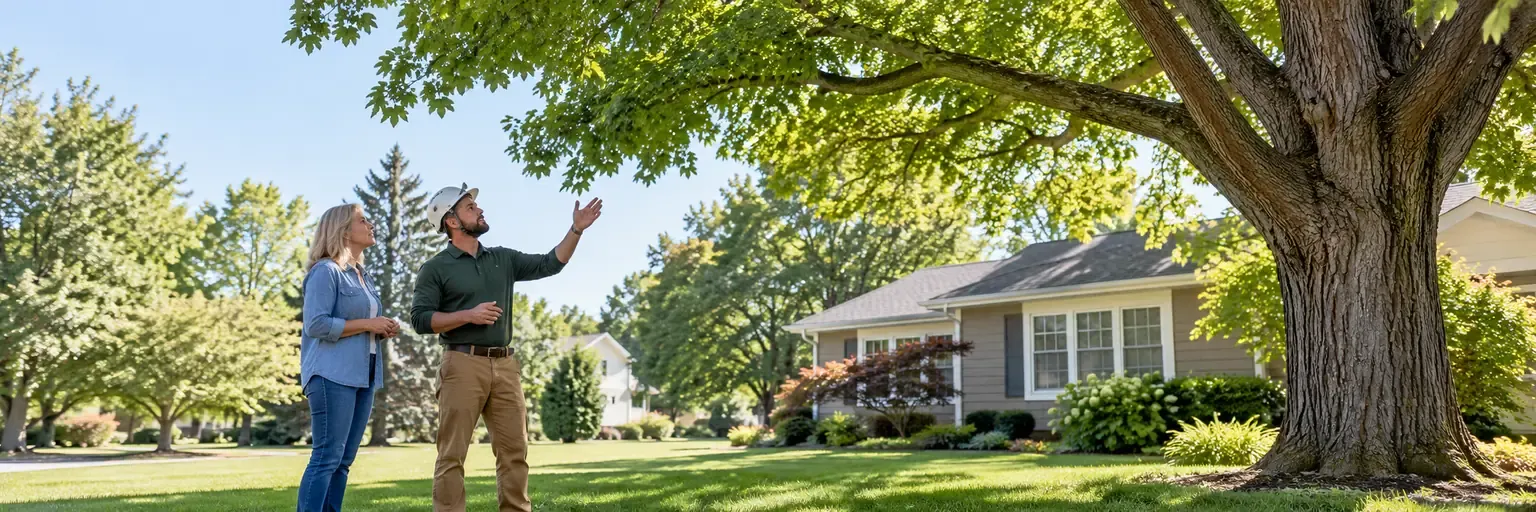
Tree trimming—more accurately called pruning—is usually the better fit when a qualified tree professional can explain a limited goal, such as clearing a safe path, removing a damaged small branch, or improving the tree’s structure, without compromising its health or stability. Removal deserves a site-specific assessment when a tree has major damage, declining condition, a conflict with a structure or utility, or a risk that cannot be addressed by appropriate pruning. Do not climb, cut, or use a ladder near a tree that is close to a power line, has hanging or broken limbs, leans suddenly, or could strike people or property. Those conditions call for a qualified professional and, for electric-line concerns, the utility’s guidance.
This guide helps a homeowner prepare for that decision. It cannot determine whether a particular tree is safe, diseased, structurally sound, or subject to local rules. A professional needs to inspect the tree, its surroundings, and the work area before recommending a scope.
Start with the job you need done
Pruning means selectively removing branches for a defined purpose. A qualified professional may recommend it to remove dead or damaged branches, improve clearance, or manage structure in a way that fits the species, age, and site. It is not the same as cutting every branch back, removing the top of a tree, or making a tree smaller because it feels tall. The International Society of Arboriculture (ISA) advises against topping—cutting back large branches to stubs—because it can create weak regrowth and stress the tree.
Removal means taking down the tree and managing the resulting wood; stump treatment or grinding may be a separate decision and scope item. It is the more disruptive choice, so ask what specific condition or conflict makes it the recommended path and whether a qualified inspection found any reasonable alternative. A removal recommendation should not be based only on leaf drop, ordinary seasonal change, or a homeowner’s preference for a different view.
If your goal is simply more light, path clearance, or a branch away from a roof, ask whether a focused pruning scope can meet that goal. If the concern is a tree that may fail, a tree damaged by a storm, a tree contacting a line, or a conflict with a structure, do not assume trimming solves it. Request an assessment that explains the observed condition, the limits of pruning, and the reason for any removal recommendation.
Know when to pause instead of DIY
Tree work can involve falls, falling objects, chainsaws, and electrical hazards. OSHA identifies struck-by, fall, and electrical hazards in tree-care operations. From the ground, you can document what you see, but you should not climb, cut overhead limbs, pull on a lodged branch, or use a ladder and power tool at the same time.
Pause and arrange qualified help when you observe:
- A broken, hanging, split, or recently fallen limb that could reach a person, path, vehicle, or building.
- A new or pronounced lean, lifted soil or roots, a trunk crack, or a cavity near a major branch attachment. These signs do not prove a tree will fail, but they merit professional interpretation.
- A tree or branch near an overhead electric line. Keep people and equipment away and contact the utility for its local process; do not attempt clearance yourself.
- Storm damage, a tree resting on a structure, or a branch that cannot be reached safely from the ground.
For an immediate emergency involving a downed line, follow the utility’s emergency instructions and local emergency guidance. Do not approach or move the line, the tree, or anything touching it.
Compare the two paths on the same facts
| What you want or can safely observe | Better next step | What to ask for |
|---|---|---|
| A small number of accessible dead or damaged branches; no line or structure concern | Request a pruning assessment | The pruning objective, branch limits, cleanup, and how the tree’s remaining structure will be considered. |
| Clearance from a roof, walkway, driveway, or sign | Ask whether focused pruning can create clearance | The needed clearance, the pruning method, future maintenance expectations, and what is excluded. |
| A tree with visible damage, a sudden lean, root-area movement, or a large split | Request a qualified on-site assessment before choosing | The observed condition, uncertainty, options, and why pruning, monitoring, or removal is recommended. |
| A branch near or contacting an electric line | Keep clear and contact the utility or a properly qualified professional | Who is authorized to perform the clearance and what work is safe around that line. |
| A proposed removal because the tree is messy, large, or inconvenient | Compare the reason with a pruning or maintenance alternative | The specific project goal, removal scope, stump decision, restoration, and replacement or site plan if relevant. |
Neither DIY pruning nor removal is an appropriate next action when the work requires climbing, rigging, line clearance, or judgment about a potentially unstable tree. A lower proposal may also represent a narrower scope, not a safer solution.
Make the site visit useful
Before the appointment, take ground-level photos from several directions and note when the change appeared, any storm or construction history, and what sits within the potential work area. Mark—not by touching—nearby structures, fences, paths, parked vehicles, visible utility equipment, and access constraints. Tell the professional about irrigation, gates, septic features, or landscaping you want protected.
Ask for a written scope that identifies the tree or trees, the stated purpose of the work, access and protection assumptions, debris handling, wood disposal, stump work if applicable, and what would trigger a change order. If permits, homeowner-association rules, or municipal tree protections may apply, ask the professional to identify what must be confirmed locally; requirements vary by location and property.
Do not treat a verbal assurance that a tree is “fine” or “has to go” as a complete decision record. A useful recommendation ties the proposed work to what was observed on site and explains what it cannot establish without further evaluation.
Your useful next step
Use How to plan a landscaping project to prepare one written brief for each visit. If the work becomes part of a larger yard project, How much should landscaping cost? can help you separate tree-work scope from other landscape items before you compare totals.
Questions to ask your arborist or qualified tree professional
- What is the specific pruning or removal objective for this tree, and which observations on site support that recommendation?
- If pruning is an option, what branches and method are included, what future maintenance might be needed, and what condition would make pruning an unsuitable solution?
- How will you protect nearby people, structures, landscape features, and utility areas; what debris, wood, stump work, and change conditions are included or excluded in writing?
Sources
- Occupational Safety and Health Administration, Tree Care Operations — tree-care fall, struck-by, and electrical-hazard context.
- International Society of Arboriculture, Pruning Your Trees — homeowner pruning principles and topping context.
- International Society of Arboriculture, Tree Owner Information — consumer context for working with qualified tree-care professionals.
Be ready for the conversation
3 questions to ask your landscape or tree-care professional
- 1What site, tree, soil, drainage, utility, or access condition did you observe, and what remains outside your scope?
- 2Which pruning, removal, planting, drainage, protection, hauling, restoration, and permit tasks are included or excluded?
- 3How will you coordinate utility location, protect the site, and obtain approval if the scope changes?
Keep planning
Related landscaping tree care guides
How much should landscaping cost?
A scope-first way to compare landscaping proposals when a national price range would hide important site, drainage, plant, and access differences.
How to plan a landscaping project: a homeowner's first steps
Turn a broad yard idea into a clear, site-aware project brief before you compare landscaping proposals.
How to compare landscaping estimates
Compare landscaping proposals by written scope, site assumptions, plant details, drainage limits, and the change process—not just the total.