
Homeowner guide
Garage door repair vs. replacement: how to choose safely
Use the door's safety systems, structural condition, and documented repair scope—not a single symptom—to decide whether garage-door repair or replacement is the better next step.
Published October 3, 2026
By the HomeFAQ Editorial Team · Reviewed for accuracy.
https://homefaq.com/garage-doors/garage-door-repair-vs-replacement/
Printing is unavailable. Use your browser’s Print command.
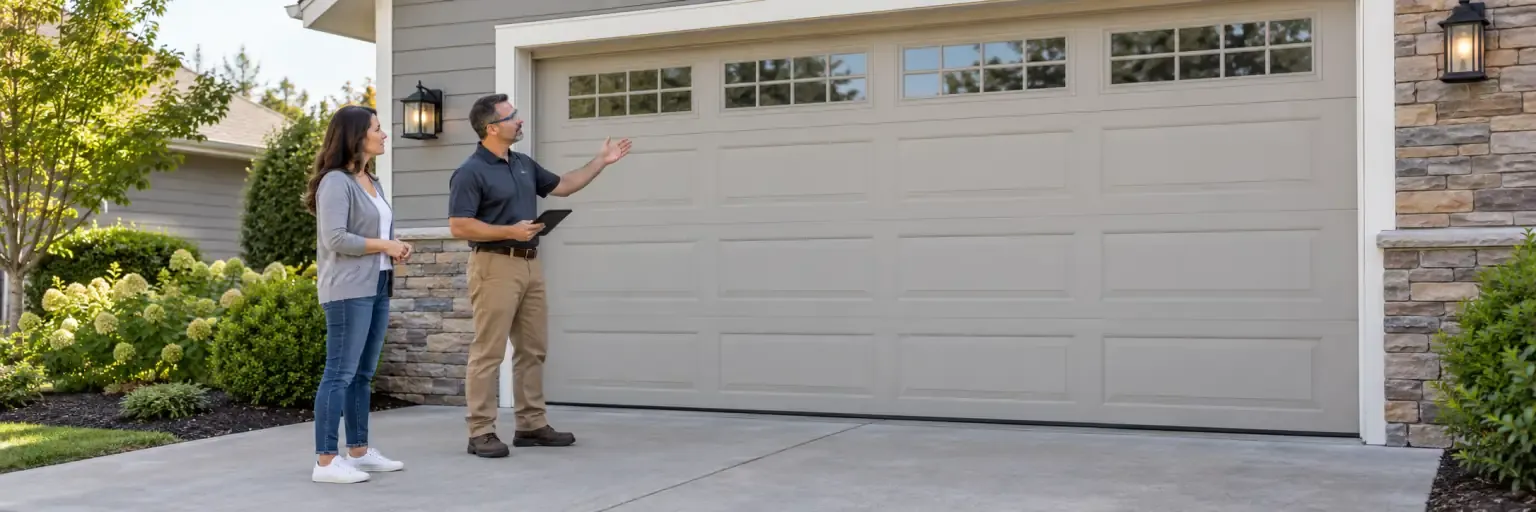
Repair is usually the better fit when a qualified garage-door technician can identify a limited problem and the door still operates safely after the repair. Replacement is more sensible when the door or its supporting parts have structural damage, needed parts are no longer available, or a safe repair would leave repeated unresolved problems. A door that will not reverse, hangs unevenly, has a loose cable, broken spring, bent track, or damaged bottom bracket needs qualified assessment before either decision. Do not try to test, loosen, or adjust those high-tension parts yourself.
This guide is for a homeowner deciding what to do with a noisy, damaged, unreliable, or aging garage door. Start with a written diagnosis of what is wrong, what the recommended work includes, and what the technician will test afterward. A repair or replacement quote is useful only when it describes the same door, opener, safety equipment, and opening condition.
Start with safety, not appearance
A garage door is a heavy moving system. Its springs, cables, drums, bottom brackets, tracks, and opener safety features work together. A dented panel may be mostly cosmetic, but a door that is crooked or leaves the track is not a cosmetic question. The Door & Access Systems Manufacturers Association (DASMA) warns that springs and related hardware are under high tension and should be handled by trained personnel.
Stop using the door and arrange qualified service if you notice a cable off a drum, a visibly broken spring, a bent or loose track, a damaged bottom bracket, a door that hangs unevenly, or movement that is abrupt or unpredictable. Also stop relying on the automatic opener if it does not complete the manufacturer-prescribed reversal test. The U.S. Consumer Product Safety Commission identifies photo-eye sensors and the entrapment-reversal system as important protections; do not bypass them to keep a door operating.
From a safe position on the floor, document the symptom: when it happens, which direction the door moves, any impact or water history, and the opener model. Photos of panel damage or a short video of a safe, normal-distance observation can help a technician, but do not repeat unsafe operation just to record it.
When a focused repair is often the better fit
Repair may be reasonable when a technician finds a contained issue and can confirm safe operation after the work. Examples can include a cosmetic panel issue that does not affect movement, a worn weather seal, a compatible opener-control problem, or a hardware concern with suitable replacement parts. The important qualifier is that the professional—not a homeowner looking at symptoms—confirms that the counterbalance system, tracks, door sections, and safety features are operating as intended.
Ask for the cause, not only the part name. “Replace a roller” or “adjust the opener” does not explain whether another condition caused the symptom. A useful repair scope says what the technician inspected, which parts will be repaired or replaced, what is excluded, and which operational and safety checks will be completed at handoff.
Repair is not a good fit if a proposed small fix is being used to avoid evaluating a safety failure, continuing structural damage, or repeated breakdowns with no clear root cause. Do not accept a workaround that disables sensors, changes settings outside the manufacturer’s instructions, or leaves a door that cannot be tested safely.
When replacement deserves a serious comparison
Replacement may be the clearer path when panels, the door structure, or the opening relationship are badly damaged; when compatible parts are obsolete or unavailable; or when several major components need work and the technician cannot provide a durable, safe repair plan. It can also be worth comparing replacement when an existing door no longer suits the opening, insulation needs, exterior condition, or compatible opener and safety equipment.
Replacement does not automatically mean replacing every nearby component. Ask the installer to separate the door, counterbalance hardware, tracks, opener, removal, weather sealing, trim, electrical work, and any opening repair. If the existing opener will stay, ask how compatibility and safety operation will be verified. If removal exposes framing, moisture damage, or an uneven opening, request a written change process before extra work begins when practical.
Local permit and wind-load requirements can vary by place and project. Rather than assume a generic rule applies, ask who will check the relevant local authority and product documentation for your home.
A practical decision path
| What you can safely observe | Better next step | Why |
|---|---|---|
| Minor visible panel or weather-seal issue; door otherwise operates normally | Request a diagnosis and a focused repair scope | A limited condition may not require a new door, but safe operation still needs confirmation. |
| Noise, slow movement, or intermittent opener behavior without an obvious hazard | Ask for an inspection before choosing | Similar symptoms can come from the opener, rollers, tracks, or counterbalance hardware. |
| Failed reversal test, sensor problem, loose cable, broken spring, bent track, or crooked door | Stop use and arrange qualified assessment | These conditions can affect safe operation; do not price-shop a DIY repair. |
| Severe panel or structural damage, unavailable compatible parts, or repeated unresolved repairs | Compare a documented repair plan with a full replacement scope | Replacement may provide a more coherent, testable system, but scope still matters. |
| A replacement proposal after an impact or removal discovery | Request written inclusions, exclusions, and change approval | The door alone may not include opening repair, trim, electrical work, or disposal. |
Compare proposals on the same scope
Whether you receive a repair recommendation or a replacement proposal, ask each professional to identify the door model or affected sections, springs and cables within the professional scope, tracks and rollers, opener and photo eyes, removal and disposal, seals and trim, warranties, and exclusions. A lower total can reflect less work rather than a better decision.
Ask what will happen after the work: will the door be operated through its travel, will the photo eyes be checked, and will the automatic reversal be tested according to the opener manufacturer’s instructions? The answer should be specific to the installed equipment. Do not treat a repair as complete merely because the door moves once.
For help making proposals comparable, read How much should garage door replacement cost?. For safe observations before the visit, use How to maintain a garage door safely. Neither guide replaces an on-site assessment.
Questions to ask your garage-door technician
- What is the root cause of the symptom, and which parts of the door, counterbalance system, tracks, and opener did you inspect before recommending repair or replacement?
- If you recommend repair, what condition would make that repair no longer a safe or durable fit, and are compatible parts available for this door?
- After the work, which door-travel, photo-eye, and manufacturer-prescribed reversal checks will you complete and show me?
Sources
- Door & Access Systems Manufacturers Association, Garage Door and Opener Safety — consumer safety context for high-tension garage-door components.
- U.S. Consumer Product Safety Commission, Automatic Garage Door Opener Safety — consumer guidance on photo eyes and entrapment-reversal systems.
- The Genie Company, Owner’s Manuals — example manufacturer source for model-specific operating and safety-test instructions.
Be ready for the conversation
3 questions to ask your garage door professional
- 1What did you test on the door, springs, tracks, hardware, photo eyes, and opener before recommending this work?
- 2Which repair, replacement, safety-test, programming, and cleanup tasks are included or excluded?
- 3What result would mean the door should stay out of use, and what will you test with me at handoff?
Keep planning
Related garage doors guides
How much should garage door replacement cost?
A U.S. scope-first guide to comparing garage-door replacement proposals when a generic national price cannot replace a written local quote.
How to maintain a garage door safely
Use simple ground-level checks and your opener manual to spot garage-door issues safely, while leaving springs, cables, and powered repairs to a qualified technician.
Garage door terms homeowners should know
Plain-English garage-door terms to help you understand a safety recommendation or compare a written repair or replacement scope.