
Homeowner guide
How to compare junk-removal quotes
Compare junk-removal quotes by matching the load, access, labor, disposal, cleanup, and written change terms before comparing totals.
Published October 4, 2026
By the HomeFAQ Editorial Team · Reviewed for accuracy.
https://homefaq.com/junk-removal/how-to-compare-junk-removal-quotes/
Printing is unavailable. Use your browser’s Print command.
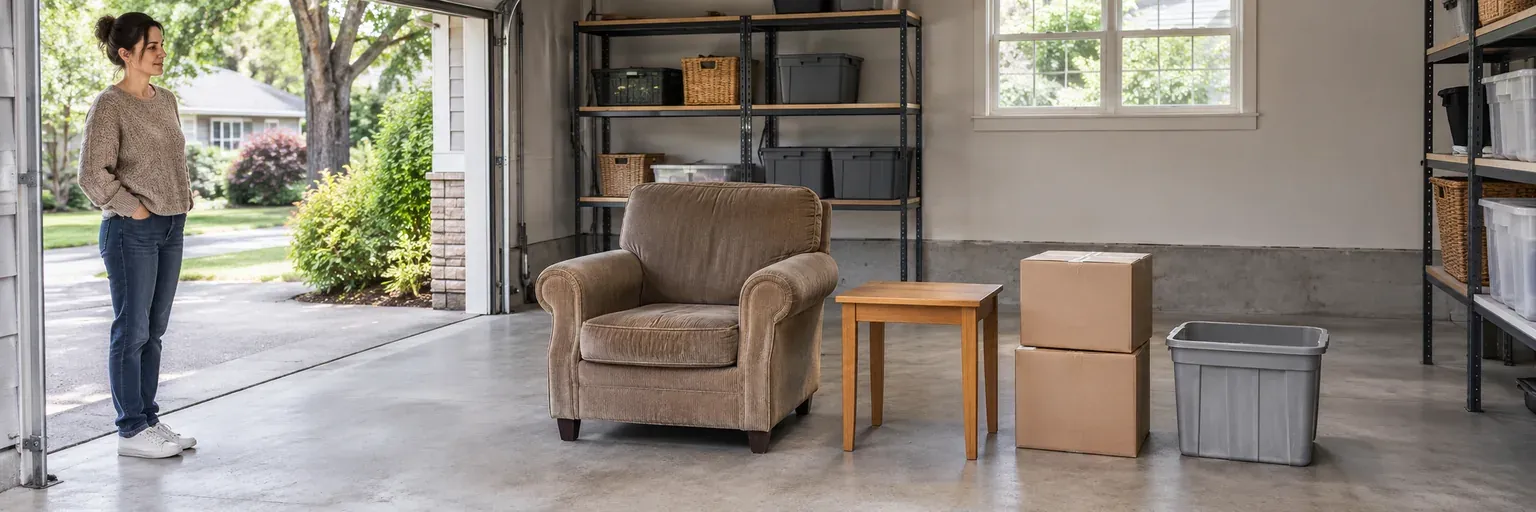
Compare junk-removal quotes only after every provider is pricing the same item list, pickup location, and access conditions. The lowest total is meaningful only when it includes the same loading labor, disposal route, cleanup, and change process. If a quote says only “one truckload” or gives a starting price, treat the missing details as unknown until the provider confirms them in writing.
This guide is for a homeowner choosing among haul-away or dumpster proposals for household items, a cleanout, or ordinary project debris. It does not decide whether a material is legal to discard locally or whether a provider must accept it. Use it to build one scope worksheet and ask each provider to confirm its own accepted-material rules. Keep hazardous, leaking, unknown, or regulated material out of a general pile while you get the right local guidance.
Start with one shared inventory
Send every provider the same item list, photos, desired pickup window, and access notes. List bulky, dense, or unusual items separately instead of calling everything a “load.” Note whether items are indoors, curbside, in an attic, basement, shed, or yard; whether there are stairs, elevators, long carries, gates, narrow paths, parking limits, or building rules; and whether anyone must be present.
A quote is a provider’s stated price for a defined scope. An estimate can be a preliminary approximation that changes after an inspection or pickup-day review. Either can be useful, but neither is comparable unless its scope is clear. The Federal Trade Commission recommends getting written estimates and understanding a contract before hiring a service provider. Do not assume a photo-based price includes a condition the photo does not show.
Put every quote on the same worksheet
Mark each item as included, excluded, allowance, or unknown. An allowance is a placeholder rather than a confirmed charge; ask what it covers and what can make it change. A provider does not need to use this exact table, but its written answer should let you complete it.
| Scope item | What to compare | Why it matters |
|---|---|---|
| Load basis | Named items, rooms or piles, vehicle/container volume, and any weight limit | “Truckload” can mean different amounts and may not describe dense material. |
| Loading labor | Indoor carrying, stairs, elevators, long carries, disassembly, and curbside requirements | A lower price may assume you move items first or may omit difficult access. |
| Accepted and excluded materials | Appliances, mattresses, electronics, tires, construction debris, loose containers, and restricted items | Acceptance and disposal routes vary; an excluded item can stop or change a pickup. |
| Disposal and fees | Disposal, recycling, transfer-station, fuel, travel, minimum, permit, overage, or rental charges | A total should say whether these charges are included or can be added later. |
| Donation claims | Organization, acceptance condition, pickup responsibility, and receipt terms | A provider cannot guarantee a charity will accept an item or issue a receipt. |
| Cleanup | Sweeping, loose debris, overflow, container removal, and what remains behind | “Removal” may not include cleanup of the pickup area. |
| Changes | Trigger, documentation, approval, price basis, and schedule effect | You need a written choice before an added condition changes the work. |
For a dumpster proposal, compare the container size, allowed materials, included weight, rental period, placement, delivery, pickup, and overage process. A dumpster is not the same scope as full-service removal: it normally leaves loading and day-to-day site control with the homeowner. Confirm local placement rules before a container is delivered to a street, shared drive, or managed property.
Check exclusions before comparing totals
Read exclusions as carefully as inclusions. Ask each provider to identify material it will not take and any preparation it expects from you. The U.S. Environmental Protection Agency directs households to local household-hazardous-waste programs for household hazardous waste, and it notes that batteries and electronics have separate disposal considerations. Do not open containers, disconnect an appliance, cut apart an item, or move an unstable load to make it acceptable for a quote.
Donation language needs a clear boundary too. A usable item may be accepted, declined, or accepted without pickup by a donation organization depending on its current rules and condition. Ask whether the provider is offering a disposal route, a delivery attempt, or a confirmed donation pickup. If you need records for a potential charitable contribution, check the organization’s documentation directly and review Internal Revenue Service guidance or a qualified tax professional for your own situation; a junk-removal quote is not tax advice.
Make labor and access visible
Two identical sofas can produce different scopes when one is at the curb and the other is in a third-floor room with a narrow stairway. Confirm the number of workers, whether the provider will carry items from every listed location, and what happens if access is blocked. Tell each bidder about parking restrictions, gate codes, elevators, building reservation requirements, long driveways, and surfaces that cannot support a container.
Do not try to make a quote cheaper by doing unsafe preparation. Keep children and pets away from the loading path, remove private documents and valuables, and stop if you find a leaking container, damaged battery, unknown material, or item too heavy or unstable to manage. The right response is to ask the provider or local program for the acceptable next step, not to hide the condition in the pile.
Get the change process in writing
A change order is a written change to the agreed scope, price, or timing. For junk removal, it can be triggered by added items, more volume or weight, a restricted material, stairs or access not disclosed, or a condition that prevents safe loading. Before booking, ask the provider to describe what it will photograph or record, who can approve a change, whether it will pause work, and how the revised total is calculated.
Do not rely on a verbal promise that “we will work it out.” A clear process lets you decline added work, remove an excluded item from the scope, or approve a documented revision before the crew proceeds. Compare cancellation, deposit, and payment terms in the same way: identify what is due, when it is due, and what happens if the scope changes or the provider cannot accept part of the load.
Choose the clearest comparable scope
- Send each provider the same inventory, photos, access notes, and pickup window.
- Complete the worksheet for every proposal; resolve blanks, allowances, exclusions, and “starting at” language in writing.
- Match loading labor, volume or weight basis, disposal fees, cleanup, timing, and accepted materials before looking at totals.
- Confirm that donation language, container placement, and any permit or building requirement have a named responsible party.
- Choose the quote that gives your actual load a clear written boundary and approval process—not simply the lowest advertised number.
Use how to plan a junk-removal project safely to prepare the inventory and access notes. Then read how much junk removal should cost for a planning framework that does not pretend a national range is your local quote.
Questions to ask your junk-removal provider
- Can you mark my item list and access conditions as included, excluded, allowance, or unknown, including indoor carrying, stairs, disassembly, loading, disposal, and cleanup?
- Which materials, volume or weight limits, donation conditions, disposal fees, and pickup-area tasks could change this written total?
- If the crew finds an added item, restricted material, or different access condition, what will you document and how must I approve the revised scope before work continues?
Sources
- Federal Trade Commission, “Hiring a Contractor” — written estimate and contract-review guidance.
- U.S. Environmental Protection Agency, “Household Hazardous Waste (HHW)” — local-program guidance for household hazardous waste.
- U.S. Environmental Protection Agency, “Used Household Batteries” — battery disposal and recycling context.
- U.S. Environmental Protection Agency, “Electronics Donation and Recycling” — local-variation and disposal-route context.
- Internal Revenue Service, Topic no. 506, Charitable Contributions — donation-record context; not personal tax advice.
Be ready for the conversation
3 questions to ask your junk removal professional
- 1Which items, areas, loading routes, labor, disposal, donation, recycling, and cleanup tasks are included or excluded?
- 2What access, parking, weight, hazardous-material, appliance, or disposal restrictions could change this quote?
- 3If an item needs a different disposal method, how will you explain the option and obtain approval before adding a charge?
Keep planning
Related junk removal guides
How much should junk removal cost?
A U.S. planning guide to comparing junk-removal, donation, and dumpster scopes when a generic national price cannot replace a written local quote.
How to plan a junk-removal project safely
Sort, measure, and document a junk-removal project so you can compare written scopes without handling unsafe or prohibited materials.
Junk-removal terms homeowners should know
Understand common junk-removal, donation, recycling, and disposal terms before you compare a pickup or dumpster scope.