
Homeowner guide
How to compare chimney inspection and repair estimates
A homeowner worksheet for comparing chimney inspection and repair proposals by findings, scope, access, testing, changes, and closeout—not just the total price.
Published October 2, 2026
By the HomeFAQ Editorial Team · Reviewed for accuracy.
https://homefaq.com/chimney-fireplace/how-to-compare-chimney-inspection-and-repair-estimates/
Printing is unavailable. Use your browser’s Print command.
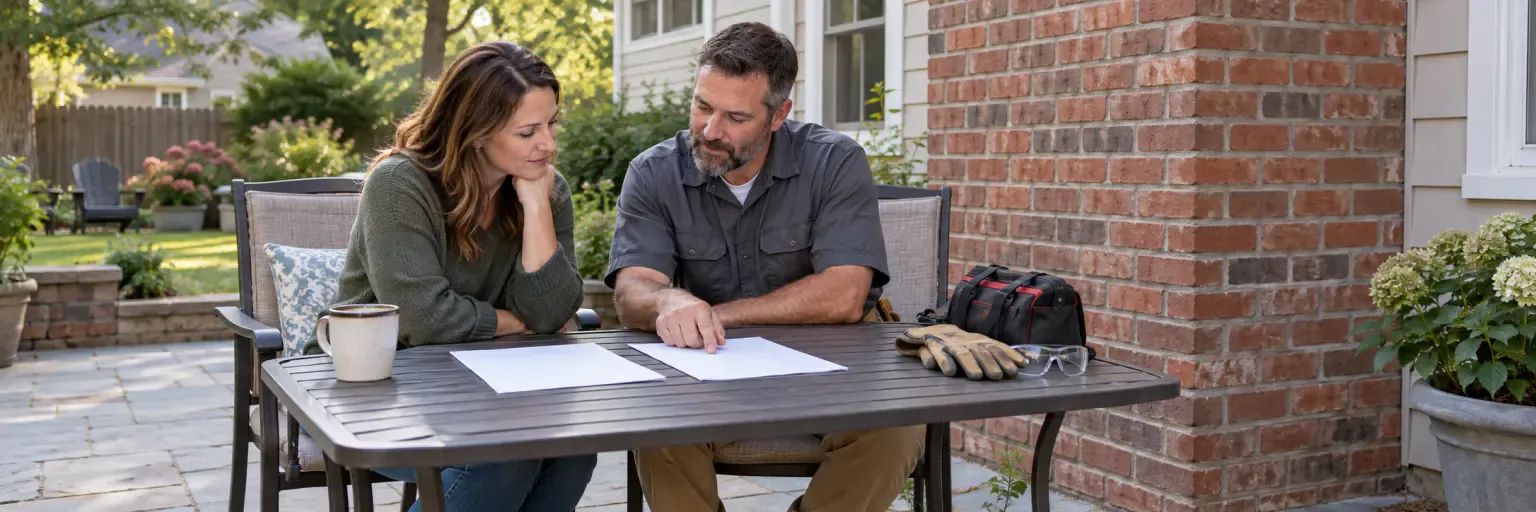
When two chimney proposals have different totals, compare the findings and written scope before comparing the price. The better proposal for your situation is the one that clearly explains the condition it observed, the inspection limits, the exact work included, and how it will confirm the system is ready for its intended use. A lower price may be reasonable for a smaller, well-defined scope; it is not automatically comparable to a proposal that includes more access, testing, repair area, protection, or documentation. Do not choose a chimney repair from a photograph or an abbreviated label alone.
Start by giving each qualified professional the same basic information: the fireplace or appliance, fuel, symptoms, prior reports, known water entry, recent changes, and any suspected chimney fire. The Chimney Safety Institute of America (CSIA) explains that inspection levels and scope depend on the situation and the areas that need evaluation. A routine accessible inspection is not necessarily the same work as an evaluation after a system change, suspected damage, or a condition that needs additional access.
If smoke enters the home, you smell fuel gas, there was a suspected chimney fire, or an appliance manufacturer or professional says not to use the system, stop using it until the appropriate qualified professional assesses it. Follow your gas utility’s emergency instructions for a gas odor and contact emergency services when appropriate.
Compare the same decision first
Before asking whether one repair proposal is cheaper, make sure the proposals answer the same question. One may be pricing an inspection to identify a condition, while another may be pricing a repair after an inspection. A proposal for a chimney crown, flashing, mortar joints, liner-related work, or a larger rebuild can each have different access, materials, and limits.
Ask each professional to separate these items in writing:
- Observed finding: What was seen, where it is, and what evidence supports the recommendation?
- Inspection limits: Which areas were accessible and which areas could not be viewed or tested safely?
- Recommended scope: What exact section or component will be inspected, cleaned, repaired, replaced, or left outside the work?
- Reason for the scope: Why is this amount of work appropriate, and what alternative was considered?
Different recommendations do not by themselves prove that either professional is wrong. They can reflect different access, inspection methods, visible conditions, or assumptions. They do mean you should resolve the difference before authorizing work.
Use this chimney proposal worksheet
Copy the table into your notes and ask each professional to mark an item included, excluded, unknown, or separately priced. A blank answer is a reason to ask a follow-up question before comparing totals.
| Proposal item | What a comparable answer should identify |
|---|---|
| System and concern | Appliance or fireplace, fuel, chimney or vent, symptoms, history, and reason for the visit. |
| Findings and evidence | Observed condition, photos or report if offered, and the limits of what was visible or tested. |
| Exact scope boundary | The chimney section, crown, flashing, liner-related component, or masonry area included and what remains outside the scope. |
| Access and protection | Roof, attic, interior, scaffolding, site protection, debris handling, and any safe-access limitation. |
| Materials and method | Repair method, materials, weather protection, and how adjoining work will be handled. |
| Cleaning and testing | Inspection, sweeping, camera work, appliance checks, or testing included, separate, or excluded. |
| Permits and local requirements | Whether the professional will investigate or obtain permits or local approvals when they apply, and who pays related fees. |
| Changes and hidden conditions | What triggers added work, how it will be documented, and that you must approve a price change before it proceeds. |
| Warranty and closeout | Written warranty terms, photos, report, care instructions, and any recommended follow-up inspection. |
Look beyond the bottom line
Do not assume the largest scope is automatically necessary or that the lowest total is a bargain. A lower proposal may exclude difficult access, a report, testing, cleanup, a material component, or an identified repair area. A larger proposal should explain the observed condition, why a smaller durable repair is not recommended, and what it will accomplish. Compare exclusions as carefully as inclusions.
For example, a proposal that says “repair chimney” is not enough to compare with one that identifies a limited masonry area, access method, material work, flashing review, cleanup, and a written closeout. Likewise, a recommendation to rebuild should identify the section involved and the finding that makes a limited repair unsuitable. Treat estimates as planning documents until you have a clear written scope; neither is a guarantee of final conditions or a substitute for local requirements.
When a second qualified assessment is useful
Consider pausing for another qualified assessment when proposals describe materially different findings, one proposal cannot identify the affected area, major access limits leave a key question unanswered, or a recommendation would substantially change the project. This can be especially important after a suspected chimney fire, a change to a fuel-burning appliance, smoke entering the room, possible gas-related concerns, or signs of movement. Tell the second professional what you are trying to clarify, but let them conduct an independent evaluation rather than asking them to simply endorse a price.
The chimney inspection cost guide explains how to request comparable inspection scopes without relying on a generic advertised price. If an inspection has already identified a condition, read chimney repair vs. rebuild before comparing a limited repair with a larger scope. Return to the Chimney and Fireplace hub for related homeowner guides.
Questions to ask your chimney professional
- Which inspection finding and access limits support this exact repair or evaluation scope, and what remains unknown?
- Which cleaning, testing, permits or local review, site protection, and closeout items are included, separately priced, or excluded?
- If you find a hidden condition, what evidence will you provide and how will you obtain my approval before changing the scope or price?
Sources
- Chimney Safety Institute of America, Chimney Inspections — inspection-level context and scope distinctions.
- National Fire Protection Association, Chimneys and Fireplaces — inspection and safe-use guidance.
- U.S. Consumer Product Safety Commission, Woodstove Safety — consumer safety context for solid-fuel appliances and chimneys.
- American Gas Association, Natural Gas Safety — gas-odor emergency precautions; follow local utility instructions.
Be ready for the conversation
3 questions to ask your chimney and fireplace professional
- 1What appliance, venting, or chimney condition did you observe, and what inspection method supports that conclusion?
- 2Which accessible areas, cleaning, camera work, testing, photos, and written findings are included or excluded?
- 3What condition would mean I should keep the appliance out of use, and how will added work require approval?
Keep planning
Related chimney fireplace guides
Chimney repair vs. rebuild: which option fits?
Use inspection findings to decide whether a limited chimney repair or rebuild evaluation fits your home, without trying to diagnose masonry or venting problems.
How much should a chimney inspection cost?
A U.S. scope-first guide to comparing chimney-inspection proposals when a generic national price cannot replace the right inspection level and a written local scope.
Chimney and fireplace terms homeowners should know
Plain-English chimney and fireplace terms to help you read an inspection report or repair proposal and ask clearer questions about scope.