
Homeowner guide
Appliance installation planning checklist for homeowners
Plan a kitchen or laundry appliance installation by checking model requirements, access, connections, delivery scope, and needed trade work.
Published October 2, 2026
By the HomeFAQ Editorial Team · Reviewed for accuracy.
https://homefaq.com/appliance-repair/appliance-installation-planning-checklist/
Printing is unavailable. Use your browser’s Print command.
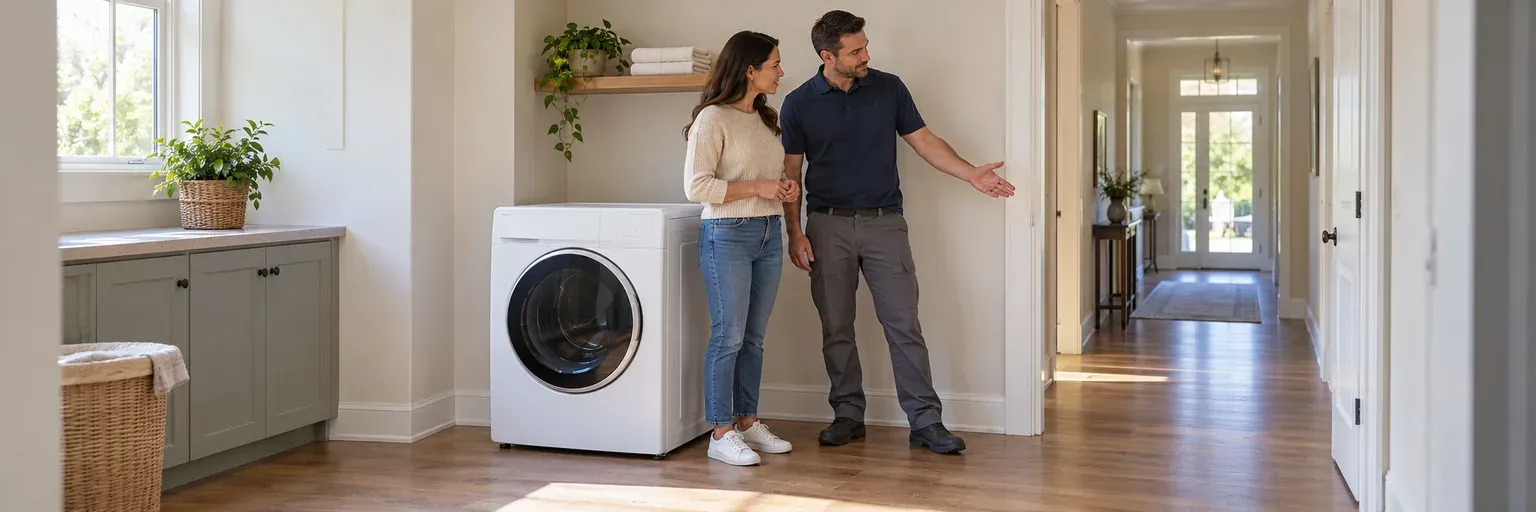
Plan an appliance installation before the truck arrives: match the exact model’s installation instructions to your room, confirm a safe delivery path, and get the complete work scope in writing. An install-only appointment can fit when the existing connections and space already meet the manufacturer’s requirements. Ask for qualified plumbing, electrical, gas, cabinetry, flooring, or dryer-vent work first when they do not. Do not treat delivery, haul-away, or an appliance price as proof that every connection and home change is included.
Start with the exact appliance
Save the model number and its installation instructions before ordering or booking installation. Requirements differ even among appliances that look similar. Instructions can identify clearances, electrical supply, water and drain connections, gas requirements, anti-tip hardware, venting, leveling, and any separately supplied parts. Keep a copy for the installer; a retailer listing alone is not a site plan.
From a dry, accessible location, measure the opening, nearby doors, hallways, stairs, and turns on the delivery route. Note fixed cabinets, flooring transitions, a laundry closet, stacked equipment, and anything that cannot be moved easily. Measure only what you can reach safely. Do not pull out a built-in appliance, remove a panel, or disconnect a cord, water line, gas connector, or vent to investigate.
Take clear photos of the route and visible installation area. Include the existing outlet, shutoff valve, drain opening, or vent termination only from a safe distance. These details help a provider identify questions before delivery without asking you to diagnose a connection.
Confirm what the home already has
Use the installation instructions as a checklist, then ask the installer to confirm compatibility. A visible connection is not proof it is correct for a new appliance. Local requirements and the manufacturer’s instructions control.
| Installation area | Confirm before delivery | Do not do yourself |
|---|---|---|
| Electrical | Required voltage, plug or hardwire method, receptacle location, circuit needs, and outlet access. | Change a receptacle, circuit, wiring, breaker, or built-in connection. |
| Water and drain | Supply valve, drain connection, hose, model-specific parts, and access for testing. | Alter concealed plumbing or repair a leaking connection. |
| Gas | Approved connector, shutoff access, and who performs connection and leak testing. | Connect, test, or modify gas piping or a gas connector. |
| Dryer exhaust | Allowed duct arrangement, termination, access, and whether the existing duct needs qualified review. | Take apart, reroute, or substitute dryer-vent materials. |
| Range stability | Whether the required anti-tip bracket is present and can engage for the model and floor. | Skip, alter, or improvise the anti-tip device. |
If you smell gas, see smoke or sparks, notice a burning odor, find water near electrical equipment, or see a damaged cord or connector, stop using the affected appliance and seek appropriate qualified or emergency help. Do not wait for a routine delivery appointment to address an immediate hazard.
Choose install-only or a home-change project
An install-only scope is reasonable when the appliance fits, the route is clear, and a qualified installer confirms the existing connections meet the exact model’s instructions. The written scope should still identify delivery, unpacking, placement, required installation kit, connection, leveling, startup testing, packaging removal, and cleanup.
Treat the work as a home-change project when the new appliance needs a different electrical supply, gas connection, water or drain arrangement, dryer duct, cabinet opening, flooring repair, structural support, or access solution. Request a separate scope from the appropriate qualified professional. That avoids expecting an appliance installer to make an unplanned electrical, plumbing, gas, or venting change outside their responsibility.
For a freestanding range, ask specifically about the anti-tip bracket. CPSC warns that an unsecured range can tip when weight is applied to an open door; the model instructions identify how its bracket must engage. For dryers, CPSC advises regular lint-filter cleaning and periodic qualified cleaning of the exhaust duct. A new dryer does not make an unsuitable or obstructed duct safe.
Put delivery and haul-away in writing
Before scheduling, ask who owns each step. A provider may offer only some of them, and a different total can be fair when the scope is different.
- Delivery to the room, not just the curb or doorway.
- Protection for floors, walls, cabinets, and the route.
- Unpacking, visible-damage inspection, placement, leveling, and startup testing.
- The installation kit, cord, hoses, connector, bracket, trim, or other model-specific parts.
- Disconnection, removal, recycling, or haul-away of the old appliance and packaging.
- Coordination with an electrician, plumber, gas professional, cabinet installer, or dryer-vent professional.
- Written approval before added work, price, or schedule changes.
Keep delivery timing flexible until the responsible provider confirms the site is ready. If a home change cannot be completed first, ask whether a reschedule is safer. Do not ask a delivery crew to bypass a required safety device or make an unsupported connection just to finish the appointment.
Bring a simple installation packet
Give the installer the exact model number, installation instructions, room and route measurements, photos, old appliance details if it will be removed, and names of professionals handling related work. Ask for the final scope, exclusions, warranty terms, and change-approval process in writing. The Federal Trade Commission advises consumers to understand written estimates and contract terms for home work; that is especially useful when installation touches more than one trade.
Next, use How to compare appliance repair and installation estimates to compare complete scopes, or use Should you repair or replace a major appliance? if you are still deciding whether a new appliance is the right path.
Questions to ask your appliance professional
- Does this exact model fit the opening, delivery route, clearances, and existing connections, and which requirements did you verify from its installation instructions?
- Which delivery, installation-kit, connection, anti-tip or venting, leveling, testing, haul-away, and cleanup tasks are included, excluded, or conditional in your written scope?
- If the site needs electrical, plumbing, gas, cabinet, flooring, or dryer-vent changes, which qualified professional owns that work and how will I approve its scope before delivery day?
Sources
- U.S. Consumer Product Safety Commission, Clothes Dryer Safety — lint-filter and exhaust-duct safety guidance.
- U.S. Consumer Product Safety Commission, Preventing Range Tip-Overs — anti-tip-bracket safety information.
- Federal Trade Commission, What to Know About Hiring a Contractor — written-estimate and contract considerations for home work.
- GE Appliances, Installation Instructions — model-specific appliance installation documentation.
- Whirlpool, Product Manuals and Literature — model-specific installation and care documentation.
Be ready for the conversation
3 questions to ask your appliance repair professional
- 1What did you test, what caused the reported symptom, and what remains uncertain?
- 2Which parts, labor, delivery, removal, connection, venting, testing, and warranty terms are included or excluded?
- 3What condition would make repair impractical, and how will you document and approve any change before work proceeds?
Keep planning
Related appliance repair guides
How to compare appliance repair and installation estimates
Compare appliance repair and replacement-installation estimates by diagnosis, parts, connections, delivery, and exclusions—not a starting price alone.
Should you repair or replace a major appliance?
Repair a major appliance when a diagnosed problem is limited; compare replacement for safety concerns, repeat failures, or changed household needs.
Appliance repair terms homeowners should know
Understand the common repair and installation terms in appliance estimates so you can compare scope, safety work, and warranty coverage.